This project explores a hacked interpretation of Vinko Globokar's ?Corporel (1985) through the lens of Pauline Oliveros' Deep Listening meditations.
Traditionally, ?Corporel is performed as a theatrical piece focused on the body as a percussion instrument, often emphasizing the struggle and the physical sound production. By introducing Oliveros' philosophy of listening as a transformative and meditative act, the performance shifts from pure theatricality to a deep investigation of sound-body relationship and relational responsibility.
The project aims to challenge the established performance practice of the piece, looking for 'transformative encounters' where the performer and the audience share a common space of sonic awareness.
Profiling: ?Corporel by Vinko Globokar
Composed in 1984, ?Corporel restricts the performer exclusively to their own body and voice. Emerging from Globokar's engagement with instrumental theatre, the work directly challenges the tendency in percussion music to equate accumulation of instruments with richness—arguing instead that a vast timbral palette can emerge from minimal means.
The score combines rhythmic notation with graphic elements, encompassing gestures from striking and rubbing body parts to humming, growling, and breath sounds. Scholars identify six episodes of increasing intensity, culminating in a spoken text by René Char and a final exhalation readable as symbolic suicide.
Profiling: Meditations by Pauline Oliveros
Oliveros' central compositional and performative concern became listening—not as passive reception but as a primary mode of engagement. She developed the Deep Listening method, which has roots in the Sonic Meditations begun in 1971.The Meditations were developed with the "♀ Ensemble"—a group including women without formal musical training—approaching listening as shared, transformative practice freed from aesthetic judgment and technical hierarchy. The scores are deliberately minimal and poetic, designed to provoke rather than prescribe. A clear example is Meditation V – Native, which invites participants to walk extremely slowly, imagining their feet as ears attuning to the ground—displacing attention from head to body and rewiring habitual perception.
Breaching in - The Body as Universal and Singular: A Productive Friction
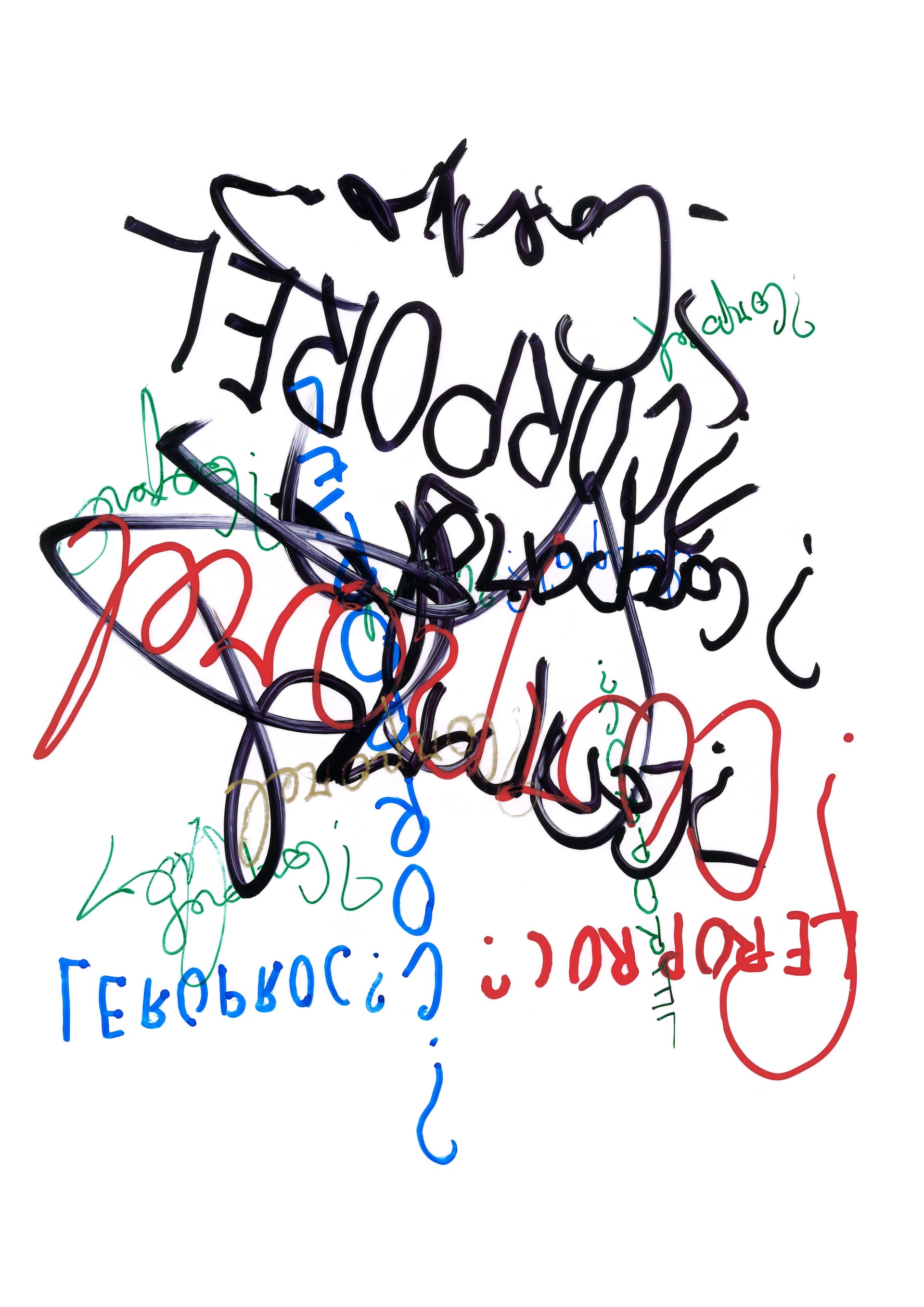
The central insight connecting both works is a productive tension between the body as universal and the body as singular—what Steven Schick, in regard to Globokar's piece, refers to as "distinguishing and universalizing tendencies". Both Globokar and Oliveros engage with broadly shared somatic capacities—breathing, striking, walking—yet these actions are always situated. Bodies carry their own histories, tempos, limitations, and abilities. Neither work attempts to resolve or smooth over this difference; both deliberately hold it open.Recognizing this tension as a vulnerability, as a site of possibility, became the guiding question of my breaching in phase: how might a practice sustain shared sonic frameworks while remaining attentive to the irreducible specificity of each body? Drawing on Tsing's notion of disturbance, I became interested in the relational textures produced when two divergent logics encounter, and disturb, one another—asking what dissonance, resonance, or unexpected spaces might emerge from bringing Globokar's and Oliveros's approaches to embodiment into dialogue. I began by fragmenting ?Corporel. I physically cut the score into segments in correspondence of the fermata signs extracting the gestures from Globokar's original sequence. This modularity became crucial for addressing the original structural disparity between ?Corporel—a self-contained piece—and the Meditations—a group of works, very evocative, etc. The fragmented Globokar's score resonated with the open-ended, non-linear character of Oliveros's texts, thus creating opportunities to juxtapose, align, or contrast individual units across the two works.
Attempting (Systematic) Pairing
My initial aim was to establish a methodological pairing system—a set of criteria grounded in shared parameters such as gesture, temporality, thematic resonance, or bodily modality. I hoped such a system would allow for formal mapping between the two bodies of work, offering systematic strategies to bring Globokar's fragments together with Oliveros' meditations. Yet after multiple attempts, it became clear that no rigid framework could accommodate the experiential, processual nature that the project had assumed through the pairing process. I realized that the meditations themselves, by resisting categorization and inviting inward attention and responsiveness to contingent surroundings, allowed for multiple pairings, undermining any attempt to codify their relationships to more defined musical gestures like Globokar's fragments. Consequently, I began to explore more flexible, intuitive strategies of pairing guided by associative resonance, grounding the connective process in my own sensibility as a hacker-performer. Practically, I laid the sections of ?Corporel on top of the printed meditations, experimenting with different juxtapositions. I looked for points where something sparked—moments in which a pairing suggested an emergent logic or a possible unfolding. For instance, sections involving text—such as F.0, which refers to the title of the piece, or F.11, which incorporates the sentence by René Char—naturally gravitated toward meditations that also engage linguistic material. In other cases, bodily positioning created a relational thread: when a section involved lying down (as in F.9), I paired it with a meditation that mirrored or resonated with that posture, such as Oliveros's *Body Tune Up. Similarly, F.7, which features rapid, percussive hand claps, found resonance with Tuning Meditation, which asks participants to tune to a shared frequency through vocal or bodily sound—both emphasizing rhythmic entrainment and collective synchronization. In retrospect, these decisions might be seen as revealing a set of loose patterns that surfaced through the act of doing. Although this approach may appear limited from a strictly analytical perspective—resisting codification, generalization, and replicability—it simultaneously foregrounds the performer's agency. By situating the process in the embodied perspective of the interpreter, it enables multiple realizations—different performers will combine the fragments differently—and gestures toward a more open-ended, assemblage-like understanding of the work
Manipulating - Documenting the Encounter: Modes of Presentation
The pairing and juxtaposition of ?Corporel and Oliveros's Meditations generated a multi-format project that unfolded across various contexts and media: live performances in concert and installation settings, intermedia installations, non-digital media (i.e. flipbook, diaries, etc.), video and audio recordings, lecture-performances, and guided tours. Each format offered a different mode of encounter—between performer and audience, between live and recorded material, between sound, gesture, and text. Rather than imposing a linear order on these fifteen fragments within the dissertation—a choice that would contradict the non-hierarchical, relational character of the project—I created an online exhibition to document and present the work. Accessible through the link provided in Section 2.4, the website functions as a dynamic archive where the fragments appear as a network of interacting elements. The order, shapes, and sizes of the fragments change each time the webpage is refreshed, echoing Latour's notion of actors in relation and foregrounding the assemblage-based understanding of the work developed throughout this research. The digital format allows online visitors to navigate the fragments in any order, juxtaposing elements in ways that generate unique resonances with each access. While the website offers a mediated form of engagement—viewers click to play videos, scroll through images, read meditation texts—it invites a mode of attention that extends beyond passive observation. Visitors can follow gestures, examine score fragments, listen to sonic relationships, and, if they feel like, try out a meditation or gesture in their own space. The online presentation thus extends the experimental methodology of fragmentation, pairing, and relational encounter into the virtual domain, allowing the project to unfold across multiple scales—temporal, spatial, and relational.
Performance setup for Globokar-Oliveros project.